There's a pattern worth paying attention to in how AI is reshaping customer support. As more routine interactions get automated, the residual queue for human agents gets considerably harder. From complex issues with multiple moving parts to emotionally charged high-stakes conversations, the interactions that reach human agents are more demanding and carry greater consequence.
This month's conversations kept returning to that reality from two different angles: what thoughtful AI deployment looks like in practice, and how support operations need to be structured to handle what automation leaves behind. We've pulled together the ideas and perspectives we think are most worth your time.
What’s worth your attention this month?
1. When evaluating AI agents for customer service, most teams are rigorous about the wrong things
Intercom's VP of Customer Support, Declan Ivory, makes a point in his article "What really matters when evaluating AI Agents for customer service?" that deserves wider circulation among CX leaders currently running or planning AI agent evaluations. Most proof-of-concept processes focus heavily on accuracy scores and resolution rates, which matter, but tell an incomplete story. The evaluation criteria that tend to get underweighted are the ones that surface in real-world conditions: how the agent behaves when it doesn't know an answer, how it handles multi-turn conversations where context needs to carry across the exchange, and how the handoff to a human agent works in practice. Getting the POC right is one problem. Getting the deployment right is a different and larger one.
2. Unplanned demand spikes are getting more common, and most outsourcing models were designed for a more predictable world
Seasonal peaks are a solved problem for most mature support operations, according to "Protecting quality during demand spikes and surges." What's harder to plan for is the surge that arrives with only a 72-hour notice or less, triggered by a transport strike, a weather event, or an overnight incident that drives a wave of inbound contacts. These situations are becoming more frequent as supply chains, infrastructure, and customer expectations grow more interconnected. Two of the traditional responses — permanent excess headcount and internal redeployment — both break under the time pressure that surge scenarios create. The article below explores what a support model built for flexibility looks like when it's put to that test.
What do we think about it?
The operations built around custom design from the start are the ones best positioned for a world where quality in every interaction is the differentiator
The traditional BPO playbook was built around standardisation, with the same processes applied to as many clients as possible. It worked for a long time, in a market where the primary question clients were asking was "how much does it cost?". That question hasn't disappeared, and it won't. The question sitting alongside it now, though, is "how good is it?", and those two questions increasingly point in different directions when the answer to the first involves templates and low margins.
Our article "Otonomee and Fin transform AI Customer Experience" investigates what the interactions that reach human agents in an AI-augmented support operation are, by definition, the ones that couldn't be resolved automatically. They need people with sound judgment, genuine empathy, the authority to make decisions, and a real understanding of the client's brand and customers. That profile doesn't come from plugging available headcount into a standard template. It comes from designing each operation around each client's specific context and hiring to match it.
Where we’ve been
1. EY Entrepreneur of the Year CEO retreat — Toronto and Ottawa
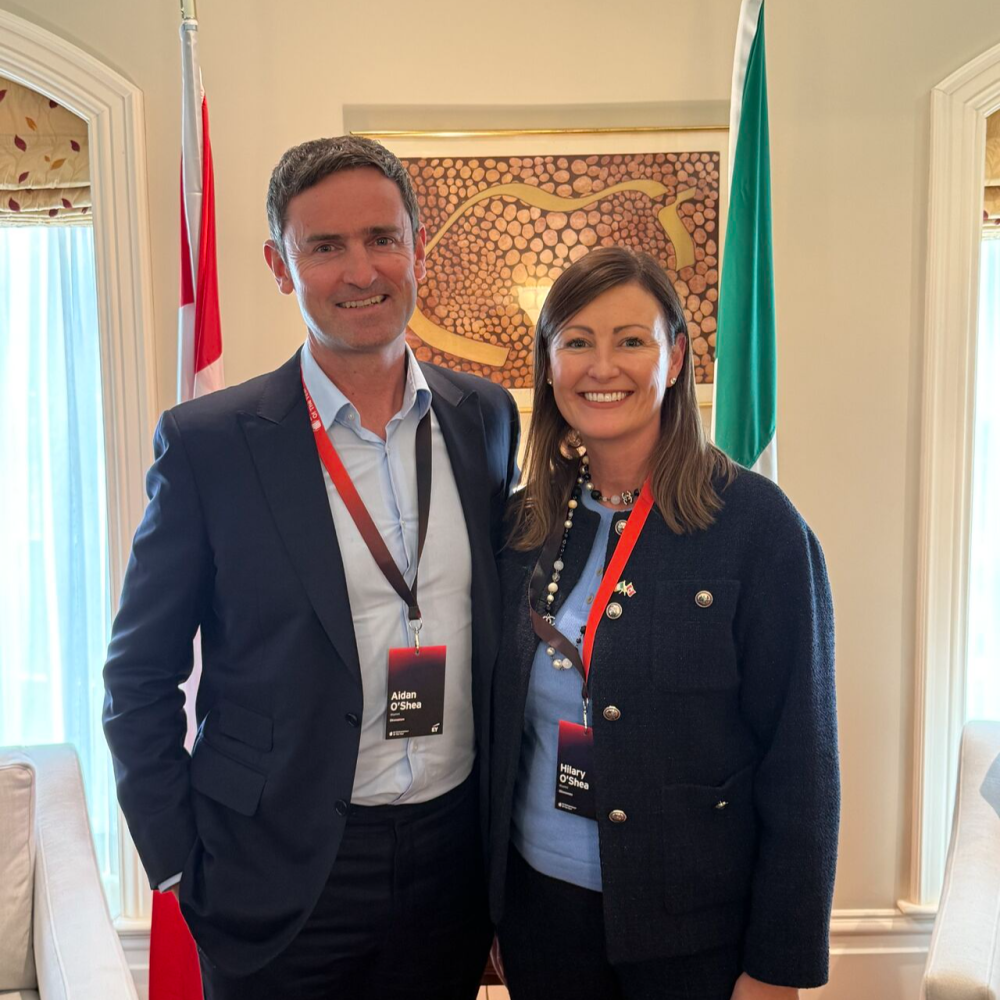
Our CEO, Aidan O’Shea, and Hilary O’Shea, our Chief Corporate Officer, joined fellow EY Entrepreneur of the Year finalists on the 2026 CEO retreat to Canada. The retreat included a visit to the Irish Embassy in Ottawa, where the group had an audience with Canadian Prime Minister Mark Carney. The discussion touched on the shifting landscape of global geopolitics and the opportunity for middle powers like Canada and Ireland to build stronger trade relationships. It was a reminder that the macro environment CX leaders are operating in, with tariffs, supply chain uncertainty, and cross-border complexity, is being shaped by decisions made at exactly that level.
2. Fin (formerly Intercom) Solution Partner Program
Otonomee joined Fin's Solution Partner Program this month, combining Fin's AI Customer Agent — which resolves an average of 67 percent of service requests — with Otonomee's experienced human teams for the interactions that remain. The partnership formalises a model we've been building toward: AI handling the standard and predictable, with skilled people focused entirely on the complex and consequential.
Closing thoughts
The question we're hearing most often from CX leaders right now is a practical one: as AI takes on more of the routine work, how do you make sure the human layer of your support operation is better trained, empowered, and matched to the interactions they're being asked to handle? Getting the AI deployment right is one part of that. Getting the human layer right is the part that tends to get underinvested.
As our CEO, Aidan O’Shea, put it this month in the Sunday Times feature: “Some traditional BPOs are like super tankers at a time when you need a speedboat.” The companies working through this transition carefully, thinking about quality, flexibility, and how the two layers of their support operation work together, are the ones we find ourselves talking to most.
If you're thinking about how to structure your support operation for the AI era, whether that's getting more from your existing teams, planning for demand volatility, or designing an operation that scales without losing quality, it's a conversation worth having early.