Pioneer – Fin – A Summit for CX Leaders Operating at the Frontier
I was fortunate to attend the recent Fin Pioneer event in San Francisco (Otonomee was a lead sponsor).
As the name suggests the gathering was a celebration of those early adopters or pioneers in CX, who are leveraging the latest AI technologies to better serve customers.
While the day included a large focus on new product and feature releases from Fin, there was also a lot of CX themes and topics covered in the various fireside chats and panels.
Below I share some of the key lessons learned on the day, but first, a little context about where Otonomee sits in the AI and CX landscape.
We are already heavily invested in AI in three main ways:
- first, we have made several key dedicated AI hires in our team over the past 12 months;
- second, we have a very strong IT function with a deep interest in and commitment to AI technology;
- and third, we have gone through a detailed process this year to become a Fin Accredited Partner
One of the guiding principles for our team is that alongside ongoing AI developments in CX, skilled and experienced people will play an increasingly important role, including working alongside AI agents, to create exceptional experiences for customers, and therefore we want to ensure our team members have the requisite skills to thrive in this new era.
In short, our AI capabilities combined with our strong CX operational roots ensures we are well placed to thrive, and help our partners thrive, in the rapidly changing global business landscape.
So, what were some of the key takeaways from the event?
- Change Creates Opportunities for Those Willing to Embrace It
Periods of immense innovation create profound uncertainty. To use an analogy from speaker Aaron Levie, CEO at Box, you can either face into the headwinds and endure a painful transition or lean in and take advantage of the AI tailwinds.
Levie argued that there will be new roles, new functions, and new ways of working.
Trying to predict what they will be right now is largely futile, but that those who are curious, resilient, and willing to relearn skills will likely thrive.
“Innovation is the ability to see change as an opportunity not a threat.” – Steve Jobs
- Resolution Rates by AI Customer Experience Agents Will Continue to Grow
There is no denying the trend: AI customer agents are improving rapidly and doing a better job every day of resolving basic customer issues.
As Eoghan McCabe, Co-Founder and CEO of Fin, said at Pioneer:
“Fin is now resolving over 10 million conversations a month, at an average resolution rate of 76%.”
There are two crucial point that can be lost in the rhetoric.
Firstly, given the ease of customer interaction with AI chatbots and agents, the volume of interactions is almost certain to increase significantly.
And secondly, with AI agents helping to resolve a high percentage of repetitive, predictable, and often tedious tasks, the remaining work to be owned by people will be more upstream, more complex, and therefore higher value for customers and business alike.
In short, as AI agent resolution rates continue to climb, skilled, experienced people with sound judgment for situations that need it will deliver more value than ever before.
- The Skills Required for Agents to Thrive are Becoming Clearer
With AI transforming the workplace, a clearer picture is emerging of the new roles and skills that will become increasingly important to exceptional CX.
For example, Alannah Carroll, one of the panellists at Pioneer, is an AI Support Engineer, a job title that did not exist a few years ago.
She described her role as follows:
“I specialize in AI support operations, with deep hands-on experience managing Intercom's Fin AI agent across multiple brand workspaces. My approach is systematic: I test 70-100 customer questions per session, analyze performance patterns, and close content gaps that prevent good self-service. I've improved Fin's "Good" ratings from 51% to 71% and resolved high-impact content gaps in the process. I track AI performance metrics for teams handling thousands of conversations daily and present monthly insights to leadership with trend analysis and actionable recommendations. My current focus is on refining how AI handles complex, multi-step troubleshooting scenarios.”
As Paul Adams, Chief Product Officer at Fin, argued:
“The human team will set the strategy. They will design the customer experience. An operator will do most of the work.”
As mentioned by various speakers, the new skills required to thrive in AI era include:
- Resilience – the ability to cope with, and not be intimidated by, rapidly changing context
- Willingness to learn – and to upskill as roles change
- Curiosity – not being set in old ways
- Adaptability – being capable of adapting
- Bias for Innovation – design and innovation
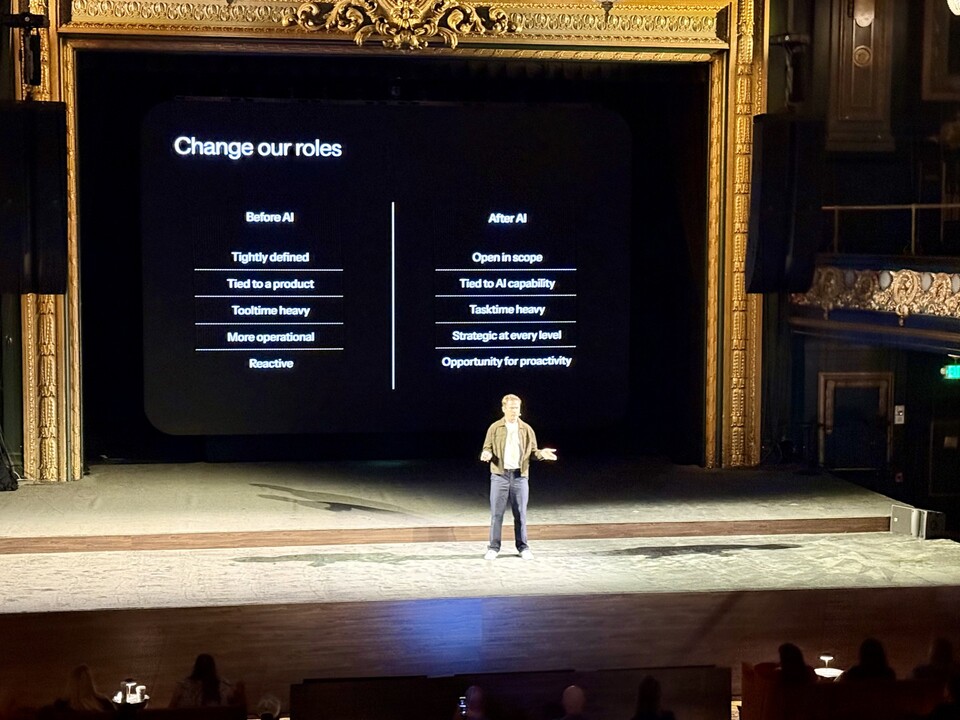
The following slide from Des Traynor's keynote, titled “We shape our tools and thereafter our tools shape us”, is also instructive.
- People Will Continue to Play a Key Role
It is worth restating this point.
While of course it was an AI heavy event there was plenty of references to the ongoing, and even elevated, importance of humans.
In part, because the demand for human interaction is still very high. Offering callers and users the ability to speak directly with someone with a minimum of hurdles was viewed as being of paramount importance. Human biology is wired for social interaction, and many users will continue to have a strong preference for human support.
Secondly, it is not just about AI resolving issues without human intervention.
AI spans a lot more and those human agents will be empowered to better serve as AI can assist is other areas too, including back-end access to data, faster retrieval of customer accounts, and instant context and summary of issue status.
AI will act as an accelerant, supporting human agents.
“We believe AI and humans will work symbiotically together. There is still a big chunk of conversations that either require humans or you actually want your humans to answer.”
Brian Donohue, VP Product at Fin
- Re-Emergence of Voice as a Preferred Channel
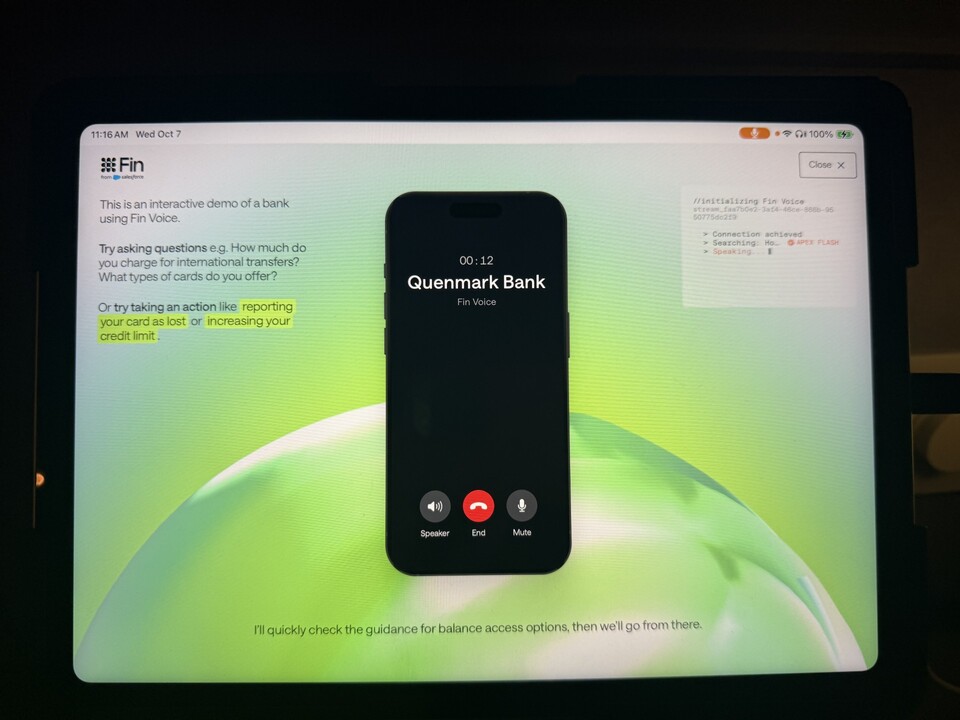
At the event Fin had placed several phone booths around the venue, where it was possible to test Fin Voice. Having tested it myself, there is no doubt that latency is low, accuracy has improved and undoubtedly resolution rates are also heading in the right direction.
Rati Zvirawa, Senior Director of AI Product @ Fin, gave a keynote titled “Why Voice will become the dominant way to interact with customers”.
During her presentation she referenced high-stakes urgent calls, such as when you spot a fraudulent bank transaction.
“In these moments customers want to be able to talk. Historically voice has always been a hard channel to scale. Every call is real time, so you need someone available. Staffing is also a challenge as demand is not linear. You have to staff for peaks and lows. And even if you do not get all these right, it is costly for you.”
Rati Zvirawa, Senior Director of AI Product @ Fin
In short, the point is that due to recent technology advances voice is likely to re-emerge as a dominant channel, with AI naturally sitting at the front.
Summary
Overall, it was an excellent event highlighting the latest upgrades to Fin, as well as the launch of several new offerings.
It also gave an indication of the direction of travel in the broader business and customer context.
AI is already profoundly impacting both software development and CX, but fundamentally it will completely transform the nature of work.
As Des Traynor remarked:
“We don't know where this is going to end up. What I do know is AI is going to change things. It will change our software, it will change our roles, it will change our organizations, and it will change our companies.”
Interested in learning more?
Watch back Pioneer by Fin | A summit for CX leaders operating at the frontier
About the Author
Alan Gleeson is the Chief Commercial Officer, Otonomee.