In our previous issues, we’ve argued that AI readiness comes before automation and that the operations seeing the strongest results from AI are the ones that started by understanding and optimizing their own foundations first.
But what does this mean in practice?
This month, we get into the practical layer of the areas worth checking before any AI agent platform decision is made, what happens when the route to a human disappears entirely, and what good data looks like once AI is doing more of the work.
What's worth your attention this month?
Before introducing an AI agent, there are five foundations worth checking, and an honest assessment is more valuable than a platform shortlist
Our latest article, “Is your support operation ready for AI?”, looks at why AI agents deliver such uneven results across organisations using similar technology. The pressure for adoption is high, with a recent Gartner survey finding that 91% of customer service leaders are under executive pressure to implement AI, yet an AI agent can only work with the knowledge it has been given and escalate along the routes designed for it.
We set out five areas worth checking before any platform decision:
- A knowledge base that is accurate, current and owned
- A view of which enquiries are repetitive enough to automate reliably
- Escalation routes mapped end to end, including a clear path to a person
- A written definition of what a good answer looks like
- A person accountable for the AI agent after launch
An honest assessment can conclude that an AI agent is not the right move yet. Most of the proposed fixes improve support for human teams regardless.
“You can focus on the low-hanging fruit and achieve 5% automation or look more strategically at where automation can deliver 20% and create significantly greater impact.” Ann-Marie Collins, Transformation Manager, Otonomee
When automation removes every route to a person, the customers it fails have only one option left: to leave
In “If Your AI Can’t Help Me, Let Me Speak to a Human“, Mark Hillary opens with the Klarna story: their 2024 announcement that AI was handling two-thirds of customer engagements, the industry panic that followed and the quiet reversal a year later when they acknowledged that people remain essential and started hiring again.
He argues that the real test of an AI-enabled support system is what happens to the customer stuck in the unpredictable 1% it was not built for, not how efficiently it handles the predictable 99%.
He makes the case through his own experience with a locked Instagram account where every recovery option fails; the AI assistant loops him back to the same dead ends, and there is no free text, no email or person available.
His conclusion is simple: automation should remove friction, not the possibility of getting help. When the final option offered to a frustrated customer is to give up and leave, companies should not be surprised when that's exactly what they do.
It is a direct illustration of why a clear escalation route to a person is one of the five foundations the readiness framework sets out.
What do we think about it?
As AI takes on the predictable work, measuring what happens in the harder conversations becomes more important
Customer satisfaction scores show how a conversation ended, but not what it took to get there. Our Quality Manager, Laura Azara, has been using AI to track how customer sentiment shifts throughout an interaction, across a far wider share of conversations than any manual QA audit could reach. Tracking customer sentiment focuses on the emotional side. Did the agent manage to appease a deeply frustrated customer so they leave the call in a far healthier state of mind?
With this extra layer of detail, team leaders get a broader evidence base for coaching, and advisors get recognition for the moments that define great support.
“When everything is judged by the final outcome alone, those standouts save-the-day moments don’t get the recognition they deserve. There’s no distinction between an easy win and a hard-earned turnaround.” Laura Azara, Quality Manager, Otonomee
Where we've been
CX Leadership Roundtable, Dublin: Otonomee and Fin bring Irish CX leaders together
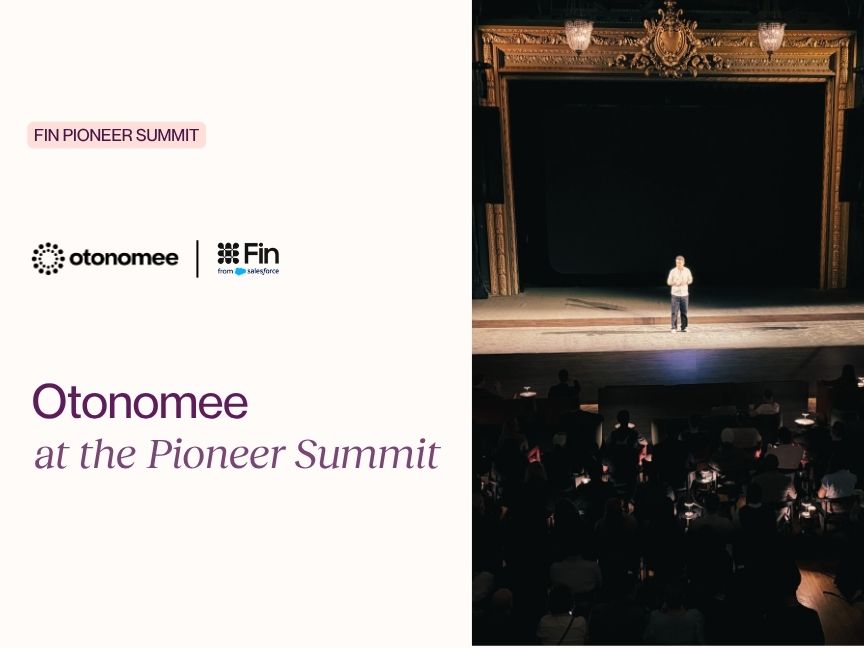
On 21 September, Otonomee and our partner Fin co-hosted an invite-only dinner in Dublin for senior CX leaders from some of Ireland's fastest-growing scale-ups.
Alan Gleeson, Otonomee’s Chief Commercial Officer, led a panel with Aidan O'Shea, Otonomee’s CEO and Co-Founder, and Declan Ivory, VP of Customer Support at Fin.
The conversation reinforced this month's main theme: AI delivers the most value on solid operational foundations, and organisations that deploy without them tend to see limited return.
Beyond operational efficiency, the conversation kept returning to a bigger ambition: support that does not just resolve issues but builds the kind of customer relationships that drive retention and long-term revenue.
How we can help
The conversations we have had most often with CX leaders this year have circled the same question from different angles: how do you make an AI implementation work, and where do you start? We have built a set of services specifically around that.
CX Optimization covers the operational groundwork that determines whether AI delivers on its promise, and the ongoing governance that keeps an operation performing after go-live. Learn more
AI Readiness Assessment is a structured evaluation of where a support operation currently stands across the five areas that most consistently determine whether AI deployment succeeds or stalls. Learn more
Fin Implementation supports companies moving onto Fin's AI Customer Agent, from initial setup and knowledge base configuration through to integration with existing workflows and handoff design. Learn more
Fin Optimization is for teams already running Fin who want to improve resolution rates, reduce escalations, and keep the knowledge current as products and processes evolve. Learn more
Closing thoughts
Getting the foundations right before you automate, designing for the customers AI cannot reach, and measuring what happens in the harder conversations are not one-time tasks. The operations with something to show for their AI investments tend to be the ones that kept at them after go-live.
If you are thinking about what that looks like for your business, we would be glad to be part of that conversation.