
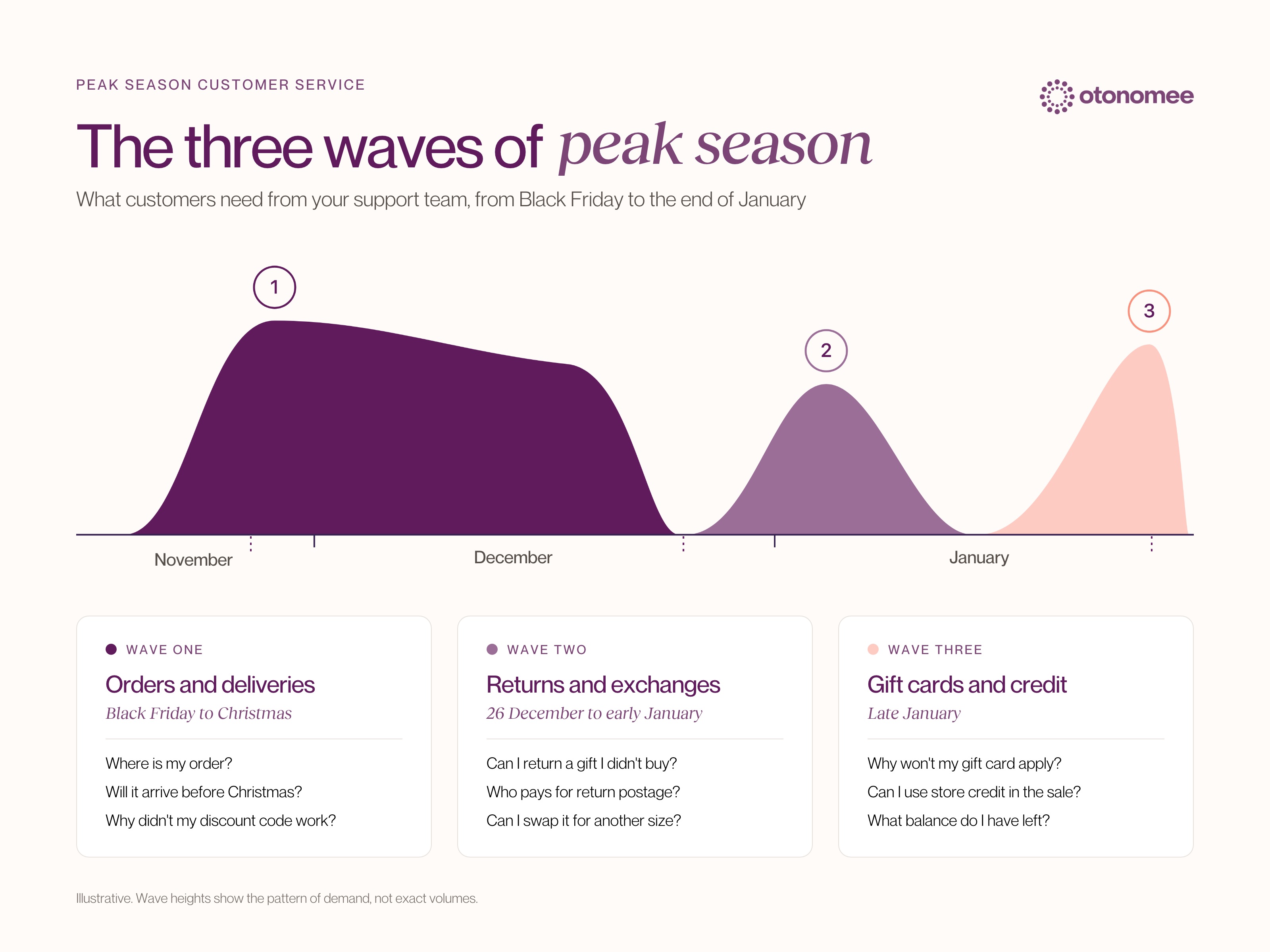
Every year, peak season tests customer service teams. The first wave starts with Black Friday at the end of November and keeps building until the last delivery dates before Christmas. The second begins on December 26th, when unwanted gifts start making their way back and the people returning them want to know how long it will take to get a refund or where they can exchange their gifts. The third arrives at the end of January, when payday and the last of January sales bring people back to spend their gift cards and store credit.
Most peak season plans are built for the first wave. The other two get less attention, even though they're often where brands meet their new customers for the first time.
Peak season runs from Black Friday to the end of January
Online holiday spending keeps breaking records. Adobe expects US shoppers to spend $275 billion online over the upcoming holiday period, 6.7% more than in 2025 (Source: Talk Business & Politics). The UK is expecting a similar increase, with nearly £30 billion forecasted, up 6.2% (Source: Retail Technology Innovation Hub).
The returns period is just as predictable. US retailers expect 17% of holiday sales to be returned, and in the UK, ZigZag recorded Boxing Day returns running 60% above Christmas Day, and ParcelHero estimated that more than £1.5 billion of unwanted goods went back to retailers in January (Source: Retail Times; InternetRetailing).
So your support team faces three surges between late November and the end of January, and each brings a different kind of conversation. A plan built only around the first leaves your CX team exposed.
The questions change with each wave
Before Christmas, most customers' queries are about orders still on their way: delivery dates, tracking, missing parcels, and discount codes. Many of these customers are buying gifts against a deadline, so a slow reply feels more serious to them than it would at any other time of the year.
January conversations, on the other hand, can be more complex. Customers want to know whether an item can be returned, who pays for the delivery, when the refund will arrive, and whether they can swap for another item or size. Some of these queries will be people who have never purchased from your brand before, creating an opportunity to turn new prospects into loyal, repeat customers.
That’s an easy win to create a new customer. Someone returning a gift has no history with you and, so far, no reason to come back. The returns conversation is their introduction to your brand, and it usually happens at a moment when they are already disappointed with the product. In many cases, the money has to go back to whoever paid, so the person holding the parcel can't be refunded at all, and what can be offered is an exchange or store credit. The way this is handled shapes their first impression of your brand. An agent who walks them through the options and helps them pick a different size or colour gives them a reason to shop with you again.
Brands that look at returns as the start of a relationship will get the most from peak season. In practice, that means briefing agents on what they can offer besides a refund and giving them autonomy to make a judgement call when an item is faulty or a return fee comes as a surprise.
Then, towards the end of January, the third wave arrives. Payday lands, the post-holiday clearance sales start and people finally spend the gift cards and store credit they were given over Christmas, including the credit they accepted in place of a refund. Last year, UK transaction volumes on Friday 30 January ran 89% above the January daily average, busier than any day in December (Home of Direct Commerce). In the US, 87% of people who received holiday gift cards had used at least half of them by February (Payments Dive).
These conversations look different again. Customers want to know why a gift card or credit code won't apply at checkout, whether it can be used on sale items, what balance is left, or when their new order will arrive. For many, this will be their first purchase from your brand, so getting these answers right builds trust and makes a second purchase more likely.
Why the returns conversations decide who comes back
Looking back on 2025, ZigZag's chief executive Al Gerrie, observed that customers remember "the pain of a bad return" over any small saving they made at the checkout (Source: Retail Times).
Wider research points the same way. Qualtrics' 2026 Consumer Experience Trends report found that 47% of bad experiences lead customers to cut their spending, and that the biggest gains from better CX showed up in industries where customers can switch brands easily (Source: Qualtrics). It also found that 30% of customers say nothing after a bad experience and simply move to another brand. So, a badly handled return in January rarely shows up as a complaint you can fix and the first sign of it may be an order that never comes the following November.
This is where customer service gives a retailer an advantage its competitors can't copy. Any brand can match your Black Friday price. Far fewer can turn a refund, an exchange, or a faulty-item query into the reason a disappointed customer decides to come back.
Peak season is also busy for fraudsters
Nearly four in ten UK retailers say Black Friday and Cyber Monday are their worst period for fraud (Source: Payabl.), and three-quarters of US retailers say return fraud gets worse over the holidays (Source: Chain Store Age).
Much of this lands on customer service, with agents receiving "item never arrived" claims and refund requests on orders that were never properly paid for. They also hear from worried customers who have received texts or emails pretending to be from your brand. Fraudsters are also now using AI to write more convincing scripts and to add urgency to their requests (Source: Security Boulevard), which makes them harder to spot in a busy queue.
The hard part for customer support teams is protecting the business without treating every gift recipient like a suspect. Tightening returns policies across the board punishes the honest customers you're trying to win over in January. Agents who know your products and customers well are much better at noticing when something doesn't add up, particularly when AI is flagging unusual patterns in the background and every return is checked against what reached the warehouse.
More customers are arriving through AI assistants
The way people find and choose new products has also changed . During the 2025 holiday season, traffic to US retail sites from generative AI tools rose 693.4% year on year, and those AI referrals converted 31% better than other traffic (Source: Adobe; Agile Brand Guide). For 2026, Adobe expects AI-referred traffic to US retail sites to grow a further 130%, and projects generative AI referrals in the UK to rise 214% across November and December (Source: Retail TouchPoints; Retail Technology Innovation Hub).
Customers who arrive via AI chatbots will often have compared options and asked an assistant about delivery times and return policies before they buy. By the time they contact your brand, the simple questions have usually been answered somewhere else. What reaches your support team is the part an assistant couldn't settle: a parcel that hasn't arrived, a returns policy that reads differently from the summary they were given, or a refund that is taking longer than promised. Those questions test the quality of your own AI customer support and the judgement of the people who step in to resolve what AI can't.
Prepare for peak season with the right customer support
The brands that handle peak season well have support teams that already know the products and the customers in detail, because the same people have been answering those customers all year. That kind of knowledge is hard to build in a few weeks, which is why temporary staff hired in November often struggle in December. An agent who has been with a brand for years can handle a difficult complaint or an unexpected returns fee with real confidence, and often without needing to refer to a handbook or knowledge base.
The other part of being ready is deciding which questions need a human touch and which don’t.
Most peak queries are predictable and an AI agent optimized against your own policies and past conversations can resolve them on its own. That leaves your team free to focus on the more complicated queries e.g. conversations that need judgement and emotional intelligence to resolve them. Those are the conversations that decide whether someone buys from you again.
This is where the right outsourcing partner earns its place. A good customer support partner keeps experienced agents on your account for the long term and works on your operation and your AI agents throughout the year, so your team is ready before volumes rise. Planning starts with a look at last season's contacts so that staffing covers the January returns peak as well as Black Friday. When demand climbs, a bench of specialists who already know your brand can step in at short notice, so the people answering still sound like you.
Returns handled from the first question to the refund
Many returns complaints start as coordination problems. The customer has sent the item back, the warehouse hasn't logged it yet, and finance won't release the refund until it does. Delivery and Returns Operations teams can handle returns from the customer's claim through to the warehouse stock transfer, working alongside your third-party logistics (3PL) and warehouse partners and in step with your finance and customer service teams. AI matches and reconciles the data, and experienced coordinators handle the exceptions. For the customer, that means their matter can be solved in one contact.
Monitor the conversations happening in public
During peak season, a late parcel or a slow refund often becomes a public social media post before it becomes a support ticket. With social media monitoring, AI tracks mentions around the clock and flags emerging issues, and experienced agents reply to the conversations that need a person. A quick reply in the brand's own voice stops one frustrated customer's post from becoming the first thing a new customer reads about you.
Insight to carry into next year
Once peak is over, it pays to look back at what it looked like, from resolution times and customer satisfaction to recurring issues, social sentiment, and returns data. Look beyond response times to the measures that show whether returns are keeping customers: satisfaction on returns conversations, time from return received to refund issued, the share of refunds that became exchanges, and how many first-time peak customers buy again within six months.
Summary
Peak season runs into January, and the returns wave is often where a brand first meets the people who received its products as gifts. Because more customers do their research through AI assistants, the questions that reach your team are also the harder ones. Brands that come through it well prepare all year, with experienced agents who know the brand and AI agents trained on the predictable questions. That's what turns a one-off gift into a customer for life.
If you'd like to talk through how your customer support is set up for both waves, get in touch.